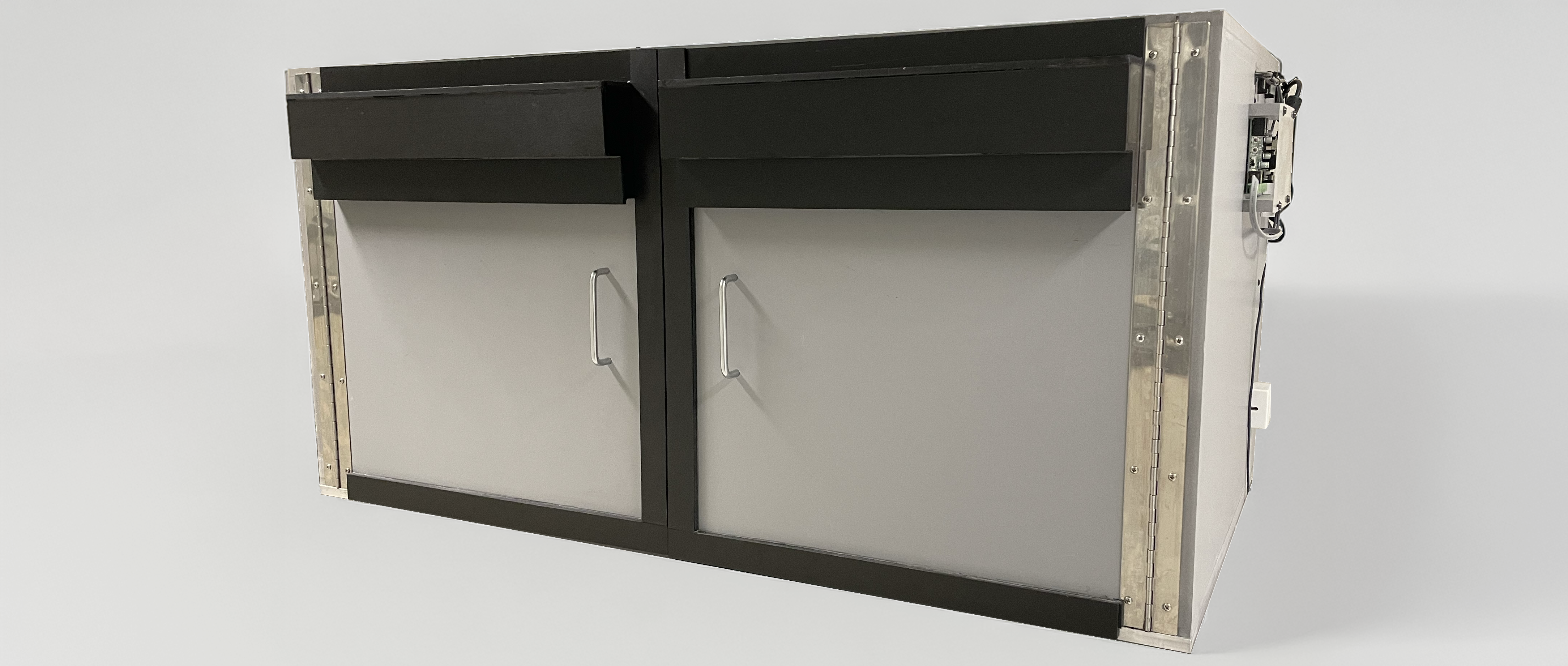
Circadian Cabinets
Phenome Technologies' circadian cabinets are our flagship product, purpose-built for rigorous circadian biology research. Each cabinet is designed to integrate our PhenomeLab software, or to work with your own computerised tracking system. Standard features include programmable LED lighting and sensor boards for continuous environmental monitoring, all within a robust, easily cleaned, light-sealed enclosure.
- Dimensions
- Standard model: 46" w x 22" h x 27" d
(116.8 w x 55.8 h x 68.5 d cm) - Capacity
- Configurable for mouse or rat caging; up to 12 mouse or 6 rat cages per unit
- Environmental
Monitoring - In-built sensor boards measure temperature, humidity, and light levels within the cabinet.
- Light Scheduling
- Programmable via PhenomeLab Software, for multiple light/dark cycles and custom photoperiods.
Custom Solutions Available
Request More InformationKey Features and Customizations
Engineered to eliminate environmental variability across every phase of the light cycle, with the flexibility to accommodate diverse research protocols.
Programmable LED Lighting Standard
Full-spectrum white, blue, and red LED arrays support precise light/dark cycle scheduling. Lighting is controllable via PhenomeLab software, TTL signals, or standard lamp timers.
Environmental Monitoring Standard
In-built sensor boards measure temperature, humidity, and light levels within the cabinet, ensuring precise environmental monitoring for experimental consistency.
Ventilation Standard
Ventilation is driven by a fan at the rear of the cabinet and exhausts at the front at approximately 28 ACH. HEPA and other filter options are available, with variable fan speed control to match protocol requirements.
Activity Monitoring Optional Customization
Integrated data rails connect directly to activity sensors for continuous, uninterrupted activity data collection. Compatible with PhenomeLab software, TTL interfaces, and silent switch systems.
Cabinet Heating Optional Customization
Heated ventilation provides heating up to 31°C, ensuring a stable and controlled environment for experiments.
Thermal Insulation Optional Customization
Additional insulation packages can be specified to improve thermal stability and reduce external temperature influence.
Light-Sealed Construction Standard
Cabinets are engineered with sanitizable surfaces, complete light isolation, and optional cable passes for external instrumentation.
RS485 Data Interface Standard
All cabinet controls, monitoring, and automated feeder communications use a reliable two-wire RS485 interface, reducing wiring complexity and enabling seamless software integration across the room.
Highly Configurable Optional Customization
Each cabinet can be sized and configured to your specification; available for mice or rats, with divided chambers, automated feeders, stacked mobile frames and more.
Sound Attenuation Optional Customization
Acoustic damping options are available to reduce ambient and mechanical noise for sensitive behavioral protocols.
RF Shielding Optional Customization
Shielding configurations can be added to reduce electromagnetic interference in environments with sensitive instrumentation.
Light-Tight Cable Pass Optional Customization
Add sealed cable pass-through options that preserve light isolation while routing external instrumentation and data connections.
Specific Wavelength Lighting Optional Customization
Custom LED wavelength packages can be configured to align with protocol-specific photobiology requirements.
Technical Specifications
| Exterior Dimensions | Standard model: 46" w x 22" h x 27" d (116.8 w x 55.8 h x 68.5 d cm); Custom sizes available |
|---|---|
| Interior Dimensions | Standard interior: 42" w x 20.5" h x 18" d (106.6 w x 52 h x 45.7 d cm) |
| Animal Capacity | Configurable for mouse or rat caging; up to 12 mouse cages or 6 rat cages (adjustable shelving available) |
| Temperature | Ambient temperature, with customization option for heating to 31 °C (thermoneutral models); passive cooling to room temperature |
| Lighting | Programmable LED (optional specific wavelengths); independently controllable via PhenomeLab software, TTL signals, or lamp timer |
| Environmental Monitoring | In-built sensor boards for cabinet temperature, humidity, and light level monitoring |
| Ventilation | Rear fan intake with front exhaust at approximately 28 ACH; variable fan speed available; HEPA and other filter options available |
| Construction | Light-sealed cabinet construction standard; optional cable passes for external instrumentation |
| Data Connectivity | RS485 interface; TTL signal output; compatible with PhenomeLab software |
| Power Requirements | 120 V / 60 Hz or 240 V / 50 Hz; custom configurations available |
Supported Research Applications
Phenome Technologies' circadian cabinets are trusted across a broad range of in vivo research disciplines requiring precise environmental control.
Circadian Biology
Precisely controlled light/dark cycles and temperature enable rigorous circadian rhythm studies in rodent models. Native integration with PhenomeLab provides automated data capture and chamber monitoring throughout the experiment.
Metabolic Research
Thermoneutral cabinet configurations and automated feeder integration support longitudinal metabolic studies with minimal handling disturbance. Hypoxia-ready variants with Okolab controller support oxygen manipulation protocols.
Behavioral Studies
Integrated wheel cage data rails, video cabinet options with IR LED illumination, and PIR activity sensors support a broad range of behavioral paradigms, including running wheel studies, open-field assays, and sound-attenuated conditioning protocols.
Ready to Discuss Your
Research Requirements?
Our team is available to provide full technical specifications, arrange a demonstration, and assist with custom configuration for your facility.